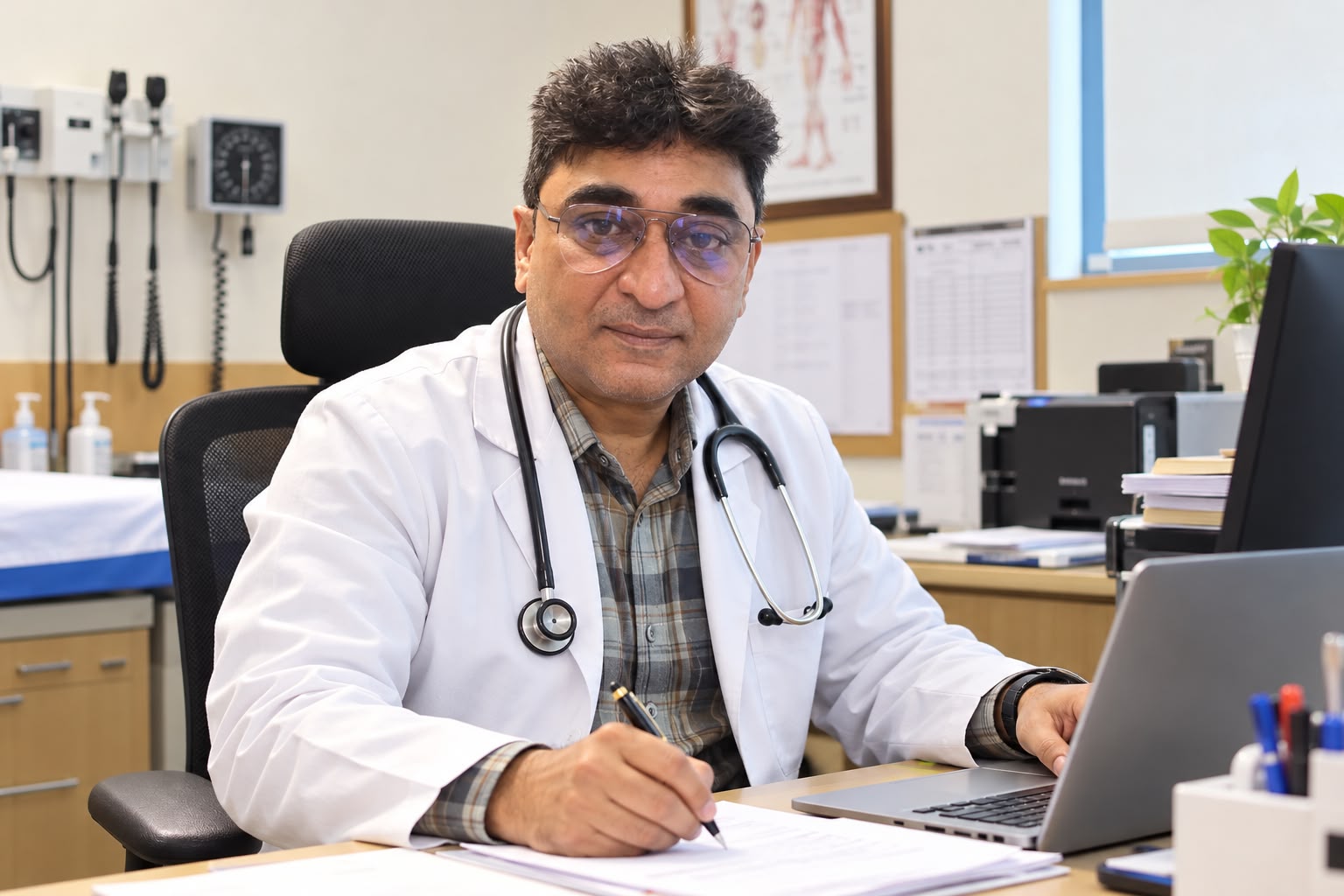
A young student once approached me after a Physiology class and asked, "Sir, will all this really help me when I become a doctor?"
The question was simple, but it stayed with me for a long time.
Like many first-year medical students, he was overwhelmed by the vastness of medicine. The endless diagrams, pathways, mechanisms, and examinations appeared disconnected from the sick human beings he would eventually treat. Years later, I met the same student in a hospital ward. He was now a young physician calmly managing a critically ill patient. As I watched him communicate with the family, interpret clinical signs, and make thoughtful decisions, I found myself silently answering the question he had asked years ago.
Not merely to pass examinations.
Not merely to earn a degree.
But to prepare an ordinary young student for extraordinary moments when another human life depends on their knowledge, judgment, and compassion.
That transformation is the real purpose of medical education.
Lessons Beyond the Textbook
Every medical teacher has two classrooms.
One is made of walls, benches, projectors, and whiteboards.
The other is made of life itself.
In the classroom, we teach cardiac physiology, respiratory mechanisms, and neural pathways. But in life, our students learn courage from a surgeon facing a difficult operation, empathy from a physician breaking bad news to a family, and resilience from a patient fighting illness with remarkable dignity.
Some of the most powerful lessons in medicine are never found in books.
I have often noticed that students remember stories more than slides.
They remember the patient whose heartbeat they heard for the first time through a stethoscope.
They remember the anxious mother waiting outside an ICU.
They remember their first night duty when fatigue battled with responsibility.
They remember moments when medicine ceased to be a subject and became a human experience.
These are the moments that truly shape a doctor.
The Privilege and Burden of Being a Medical Teacher
There is a unique drama in medical education.
Every year, young students arrive at medical college carrying dreams, ambitions, and sometimes fears. They come from different backgrounds, different towns, different cultures, yet they all share one aspiration: to become doctors.
We meet them when they are uncertain.
We watch them struggle.
We see them fail and rise again.
We witness their confidence grow.
And then one day, almost unexpectedly, they leave our classrooms and become our colleagues.
Few professions offer the privilege of watching human potential unfold so closely.
At the same time, teaching medicine carries a profound responsibility.
An engineer's mistake may affect a structure.
A lawyer's error may affect a case.
A doctor's mistake may affect a human life.
Therefore, every lesson taught today echoes in the hospitals of tomorrow.
This realization humbles every sincere medical teacher.
The Heart Behind the Science
Modern medicine is advancing at breathtaking speed. Artificial intelligence, simulation laboratories, virtual patients, digital learning platforms, and precision medicine are transforming healthcare.
Yet despite all technological advancements, one truth remains unchanged.
They seek someone who listens.
Someone who understands.
Someone who cares.
No machine can replace the reassuring touch of a physician who says, "We will do our best."
No algorithm can fully replicate empathy.
No artificial intelligence can comfort a frightened family.
For this reason, medical education must teach the heart alongside the brain.
Knowledge without compassion can become arrogance.
Skill without ethics can become dangerous.
Technology without humanity can become cold.
The true physician must possess all three: competence, compassion, and character.
The Day I Understood Medical Education
Many years ago, as a young teacher, I believed my responsibility ended when I completed a lecture successfully.
Today, I know better.
Medical education is not measured by how well I teach.
It is measured by what my students become.
A teacher may never know how many lives are indirectly touched through his students.
A diagnosis made correctly.
A life saved in an emergency.
A patient comforted during suffering.
A family reassured during uncertainty.
In a way, every medical teacher lives many lives through the work of their students.
This is perhaps the most beautiful aspect of our profession.
Looking Ahead
The future of medical education will undoubtedly involve more technology, more innovation, and more scientific advancement.
Yet its soul must remain unchanged.
Our mission is not simply to produce doctors.
Our mission is to nurture healers.
To develop professionals who combine scientific excellence with human values.
To inspire lifelong learning.
To preserve the trust that society places in the medical profession.
Because at the end of the day, medicine is not merely about diseases, investigations, and treatments.
It is about people.
And medical education is the process through which one generation of doctors prepares the next to serve humanity.
Conclusion
When I stand before a class of first-year medical students today, I no longer see future examination candidates.
I see future physicians. Future teachers. Future researchers. Future leaders.
Most importantly, I see future guardians of human health.
That thought fills me with hope.
For every lecture delivered, every practical conducted, every student mentored carries the possibility of improving countless lives in the years to come.
And that is why medical education is not just an academic activity. It is one of society's most meaningful investments in the future.