






Common Teaching Programme
A common academic platform for faculty members and postgraduate students to promote multidisciplinary learning, academic excellence, clinical integration, teaching skills and professional development.
Academy of Medical Sciences
Andhra Medical College, Visakhapatnam
The Common Teaching Programme (CTP) is a unique academic initiative of the Academy of Medical Sciences, Andhra Medical College, designed to promote interdisciplinary learning, academic excellence, clinical integration and teaching skills enhancement among faculty members and postgraduate students.
CTP serves as a common academic arena where experts from various departments come together to discuss important clinical conditions, recent advances, integrated approaches to patient care, mortality reviews, interesting cases, academic discussions, faculty development activities and postgraduate colloquia.
Objectives of the Common Teaching Programme
Strengthening academic culture and collaborative learning across departments.
Teaching–Learning Excellence
To strengthen the teaching-learning environment within the institution.
Multidisciplinary Interaction
To encourage multidisciplinary academic interaction among departments.
Presentation Skills
To improve the presentation, communication and teaching skills of faculty and PG students.
Evidence-Based Practice
To promote evidence-based clinical discussions and integrated patient care approaches.
Case-Based Learning
To provide a platform for case-based learning and academic exchange.
Professional Development
To encourage continuous professional development and academic leadership.
Emerging Healthcare Challenges
To facilitate discussions on recent advances, emerging diseases and healthcare challenges.
Major Activities Under CTP
Clinical & Multidisciplinary Discussions
Integrated discussions involving multiple specialties on important clinical conditions and patient management approaches.
Mortality Meet Discussions
Periodic institutional mortality review meetings to promote clinical audit, reflective learning and quality improvement in patient care.
PG Colloquium
Interactive academic presentations by postgraduate students aimed at improving scholarly discussion and presentation skills.
Interesting Case Presentations
Presentation and discussion of rare, challenging or educational clinical cases from various departments.
Faculty Development Sessions
Sessions conducted by the Medical Education Unit and senior faculty focusing on teaching methodologies, curriculum implementation and academic growth.
Guest Lectures & Orations
Invited talks by eminent academicians and clinicians on recent advances and important medical topics.
Beyond the White Coat: From Silence to Support
A special academic programme on mental health, awareness and support.
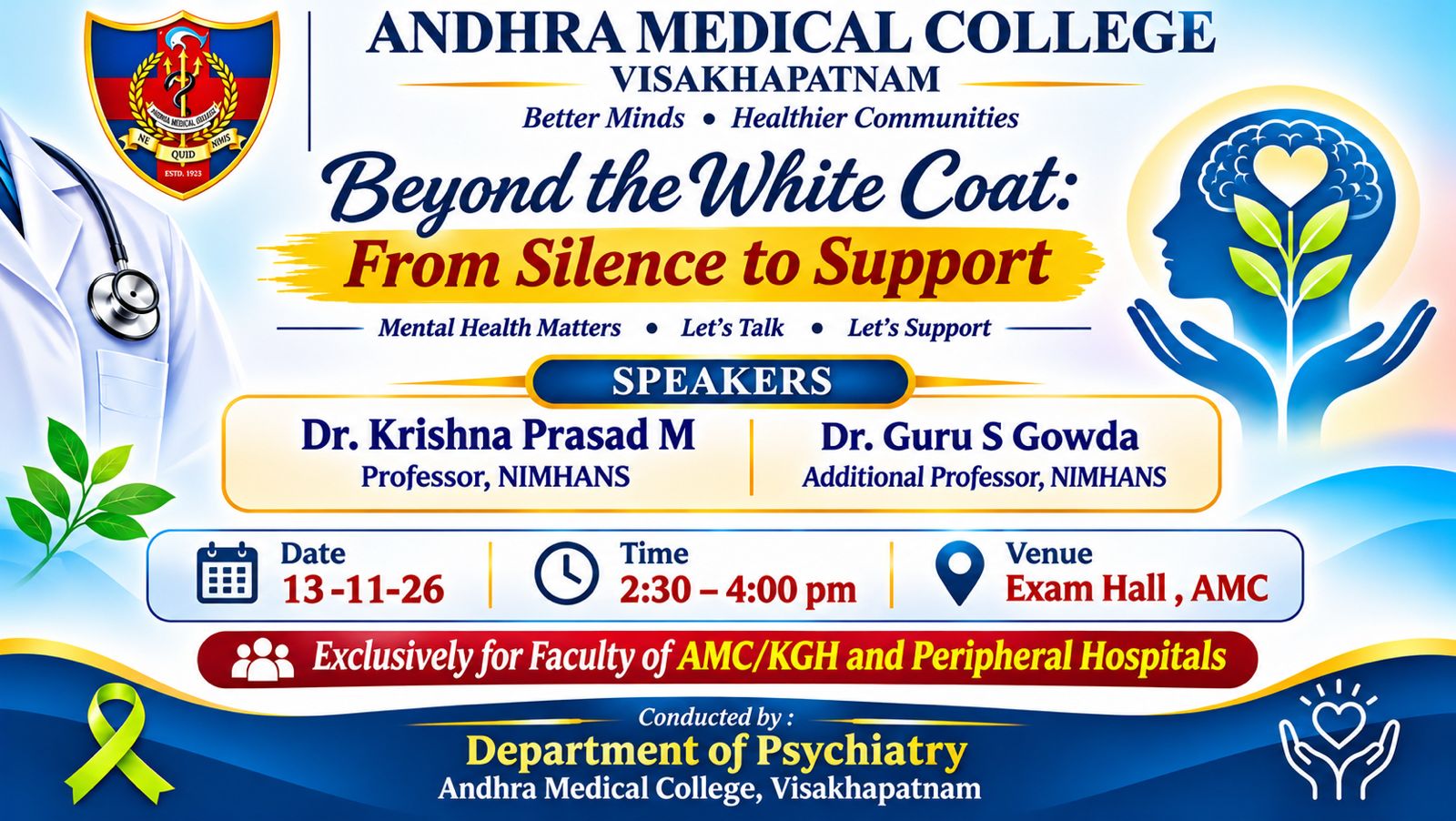
Beyond the White Coat: From Silence to Support
An academic programme organised through the Common Teaching Programme of the Academy of Medical Sciences, Andhra Medical College.
Organising Department: Department of Psychiatry
Audience: Exclusively for Faculty of AMC/KGH and Peripheral Hospitals.
View Programme PosterPG Colloquium – 4 December 2026
Academy of Medical Sciences • Andhra Medical College, Visakhapatnam
Participating Departments
The PG Colloquium will bring together five departments to discuss the systematic evaluation of Fever of Unknown Origin, integrating clinical assessment, microbiological investigations, pathology, diagnostic imaging and respiratory medicine.
Specific Learning Objectives
General Medicine
- Define Fever of Unknown Origin (FUO) and classify its major categories.
- Elicit a comprehensive clinical history and perform a focused physical examination in patients presenting with prolonged unexplained fever.
- Formulate differential diagnoses covering infectious, neoplastic, inflammatory and miscellaneous causes of FUO.
- Develop a systematic, stepwise diagnostic approach based on clinical findings and initial investigations.
- Interpret clinical and laboratory findings to prioritise further diagnostic investigations.
- Formulate an evidence-based management plan through multidisciplinary collaboration.
Microbiology
- Identify common infectious causes of FUO, including tuberculosis, enteric fever, infective endocarditis, brucellosis and fungal infections.
- Select appropriate microbiological specimens and investigations based on the suspected infectious aetiology.
- Explain the principles of blood culture collection, processing and interpretation.
- Discuss the role of serological tests and molecular diagnostic techniques in identifying infectious causes of FUO.
- Interpret microbiological reports in correlation with clinical findings and other investigations.
- Explain the importance of antimicrobial stewardship and rational empirical antibiotic use in patients with FUO.
Pathology
- Identify important haematological and malignant causes of FUO, including lymphoma and leukaemia.
- Interpret complete blood count and peripheral blood smear findings in patients with prolonged fever.
- Explain the indications for bone marrow aspiration and biopsy in the evaluation of FUO.
- Discuss the diagnostic role of lymph node biopsy and other tissue biopsies.
- Recognise characteristic histopathological patterns, including granulomatous inflammation and malignant infiltration.
- Correlate haematological and histopathological findings with clinical and microbiological data.
Radiodiagnosis
- Explain the role of diagnostic imaging in the evaluation of FUO.
- Select appropriate imaging modalities, including ultrasonography, chest radiography, CT and MRI, based on clinical indications.
- Identify imaging features suggestive of tuberculosis, occult abscesses, lymphadenopathy and malignancies.
- Discuss the role and limitations of FDG PET-CT in selected patients with FUO.
- Explain the role of image-guided aspiration and biopsy in obtaining diagnostic tissue samples.
- Correlate radiological findings with clinical, microbiological and pathological results.
Respiratory Medicine
- Identify pulmonary and extrapulmonary tuberculosis as important causes of prolonged unexplained fever.
- Recognise the clinical and radiological manifestations of pulmonary, miliary and disseminated tuberculosis.
- Select appropriate respiratory specimens and investigations, including sputum microscopy, CBNAAT/Truenat, mycobacterial culture and drug-susceptibility testing.
- Discuss the differential diagnosis of chronic pulmonary infections presenting with prolonged fever.
- Explain the diagnostic approach to tuberculosis in patients with negative initial sputum investigations.
- Discuss the principles of diagnosis, treatment and follow-up of tuberculosis presenting as FUO.
Integrated Learning Outcomes – All Departments
- Apply a systematic and evidence-based approach to the evaluation of FUO.
- Integrate clinical, microbiological, pathological and radiological findings to establish a probable diagnosis.
- Prioritise investigations based on clinical clues and diagnostic yield.
- Recognise the importance of multidisciplinary consultation in complex diagnostic cases.
- Present and defend a differential diagnosis using clinical and investigative evidence.
Proposed Time Allocation – 90 Minutes
| Department / Activity | Time Allotted |
|---|---|
| General Medicine | 15 minutes |
| Microbiology | 12 minutes |
| Pathology | 12 minutes |
| Radiodiagnosis | 12 minutes |
| Respiratory Medicine | 12 minutes |
| Integrated clinical case discussion | 15 minutes |
| Questions & Answers | 7 minutes |
| Concluding remarks | 5 minutes |
| TOTAL | 90 MINUTES |
Instructions to PG Presenters
- Each department should nominate one postgraduate presenter.
- Presentation should be focused on the assigned SLOs.
- Use clinical cases, relevant images, laboratory reports and radiological findings.
- Avoid lengthy theoretical descriptions.
- Maintain interdisciplinary correlation with the common topic.
- Keep 2–3 minutes for questions within each presentation.
Suggested Presentation Sequence
- 01 – General Medicine: Clinical approach and diagnostic algorithm.
- 02 – Microbiology: Infectious aetiology and investigations.
- 03 – Pathology: Haematological and histopathological evaluation.
- 04 – Radiodiagnosis: Imaging approach in FUO.
- 05 – Respiratory Medicine: Tuberculosis and other respiratory infections.
Mentor for this CTP Topic
Dr Gopal Rao
Professor, General Medicine, AMC / KGH
Participant Registration
All concerned departments are requested to register the participation of their postgraduate students with:
WhatsApp: 9963123125
Email: psnrajuamc@gmail.com
Vice President, Academy of Medical Sciences, AMC
Registration deadline: 25 November 2026.
The uploaded programme identifies the date as proposed. Venue and starting time are not specified in the programme document.
Common Teaching Programme Schedule
The CTP schedule includes multidisciplinary seminars, mortality meets, PG colloquia, interesting case discussions, faculty presentations and guest lectures.
| Programme | Details |
|---|---|
| Common Teaching Programme | Faculty and postgraduate academic programme, 2024–2026 |
| Programme format | Multidisciplinary seminars, mortality meets, PG colloquia, interesting case discussions and guest lectures |
| Official schedule | Open the official CTP Schedule PDF |
Useful Links & Institutional Connections
Direct access to related academic activities and institutional resources.
Medical Education Unit
Faculty development, curriculum implementation and medical education activities at AMC.
Visit Medical Education Unit →Faculty Development Programme
Common Teaching Programme and academic programme information.
Faculty Development Page →AMC Departments
Explore the academic departments participating in multidisciplinary teaching and learning.
Explore Departments →Postgraduate Courses
Information about postgraduate medical education at Andhra Medical College.
Explore PG Courses →AMC Academic Schedules
Access academic schedules and curriculum-related resources.
Academic Schedules →Advancing Excellence in Medical Education
To create a vibrant institutional academic culture that promotes collaborative learning, excellence in teaching, critical thinking and quality patient care through continuous interdisciplinary interaction.