Welcome to Andhra Medical College
red-logo1-1

The recorded onset of medical education in Visakhapatnam can be traced to 1902, when the Victoria Diamond Jubilee Medical School was set up in the Old Post Office area supported byMaharajah Sir Goday Narayana Gajapathi Rao and Maharani Lady Goday Chitti janakiammah.

Quick Contact:
Follow Us:

The recorded onset of medical education in Visakhapatnam can be traced to 1902, when the Victoria Diamond Jubilee Medical School was set up in the Old Post Office area supported byMaharajah Sir Goday Narayana Gajapathi Rao and Maharani Lady Goday Chitti janakiammah.

Quick Contact:
Follow Us:

Department of Human Physiology was started in July 1923 along with the Medical College with Dr.M.L. Kamath as the first Professor followed by several Stalwarts.  The Department was selected as one of the 7 centres for Neurophysiological work in India in 1963 under Dr P Brahmayya Sastry by the International Brain Research Foundation. The dept. has awarded many Ph.D. and MD degrees.

Human physiology is a branch of science that focuses on the study of how the human body functions. It covers a wide range of topics, including the structure and function of cells, tissues, organs, and systems within the body. The Human Physiology department is a department within Andhra Medical College that is dedicated to the study of human physiology. This department typically employs researchers and faculty members who specialize in various aspects of human physiology, and offers undergraduate and graduate degree programs in the field.
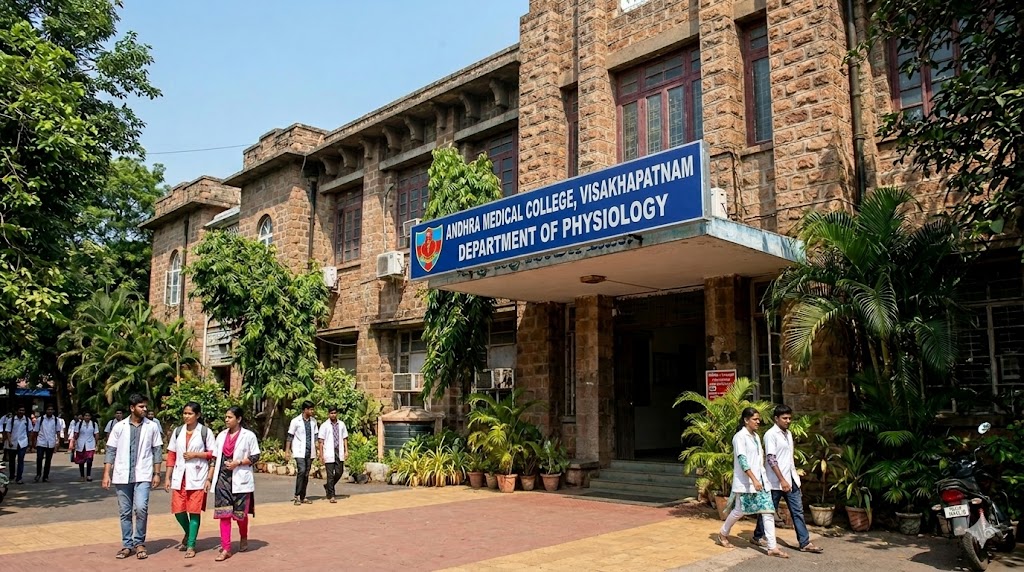
Department of Physiology

Department of Physiology – Andhra Medical College

The Department of Physiology at Andhra Medical College is one of the foundational pre-clinical departments involved in teaching, research, laboratory training, and clinical integration for undergraduate and postgraduate medical education.

About the Department

Physiology is the branch of medical science that studies the normal functioning of the human body. The department plays a major role in helping medical students understand how various organ systems work and how physiological mechanisms maintain health.

The Department generally functions under the curriculum guidelines of the National Medical Commission (NMC) and follows the Competency-Based Medical Education (CBME) framework.

Major Functions of the Department

  1. Undergraduate Teaching (MBBS)

The department teaches 1st MBBS students and provides:

Theory Teaching

Topics include:

  • General Physiology
  • Blood & Body Fluids
  • Nerve-Muscle Physiology
  • Cardiovascular System
  • Respiratory System
  • Gastrointestinal System
  • Renal Physiology
  • Endocrinology
  • Reproductive Physiology
  • Neurophysiology

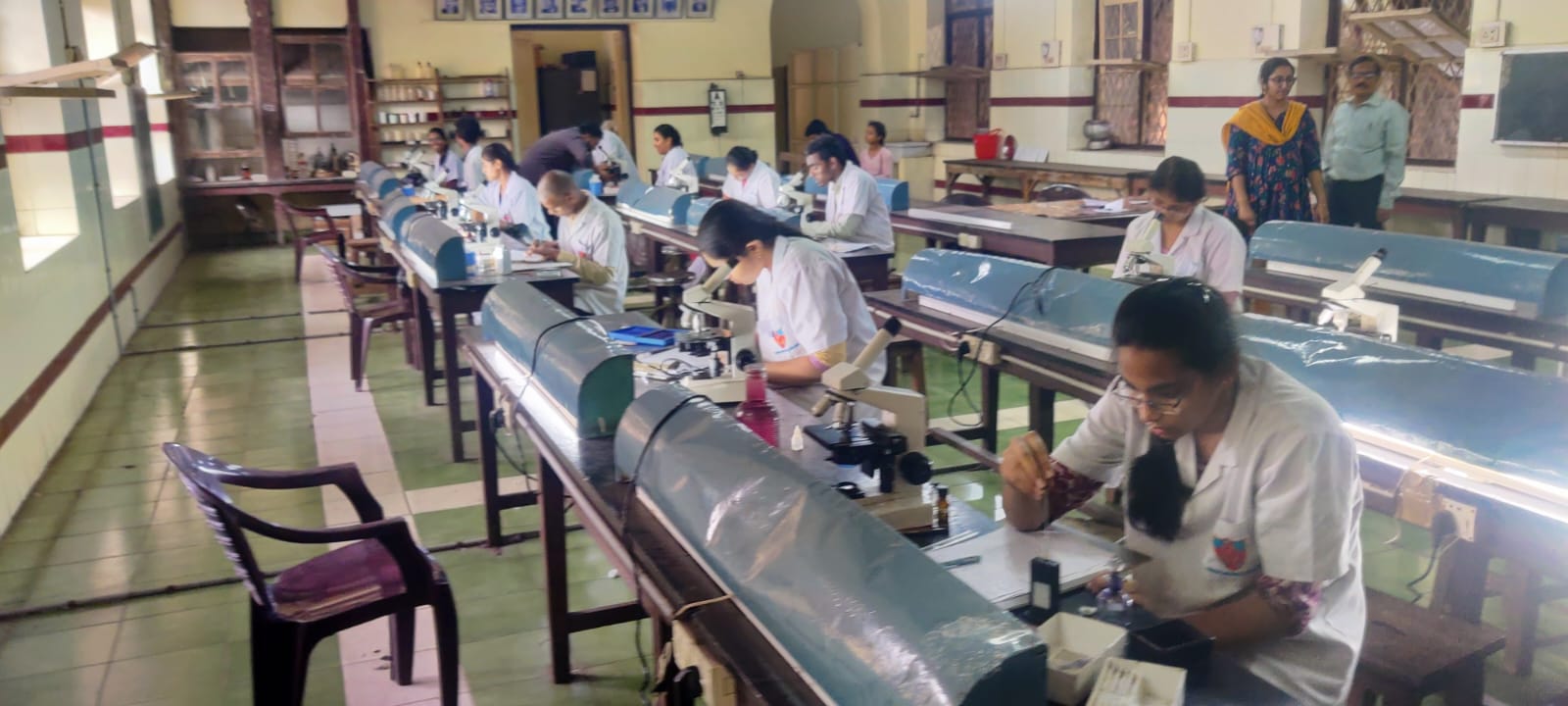
Practical Training

Students are trained in:

  • Hematology experiments
  • Clinical examination techniques
  • Blood pressure recording
  • Pulse examination
  • Spirometry
  • ECG basics
  • Anthropometry
  • Human experiments

Small Group Teaching

  • Tutorials
  • Integrated sessions
  • AETCOM modules
  • Case-based discussions
  • SDL (Self Directed Learning)
  1. Research Activities

The department participates in:

  • Basic and applied physiology research
  • Clinical physiology studies
  • Interdisciplinary projects
  • Student ICMR STS guidance
  • Publications in medical journals
  • Conference presentations

Common research areas:

  • Exercise physiology
  • Cardiovascular physiology
  • Neurophysiology
  • Pulmonary function studies
  • Stress and sleep physiology
  • Lifestyle disorders
  1. Laboratory Services

The department usually maintains:

  • Haematology laboratory
  • Clinical physiology laboratory
  • Research laboratory
  • Demonstration halls
  • Skill-based teaching stations

Some departments also assist in:

  • Pulmonary function testing
  • Autonomic function testing
  • ECG demonstrations
  • Fitness assessment
  1. Postgraduate (MD Physiology) Training

MD Physiology seats(12) are available, the department conducts:

  • Postgraduate seminars
  • Journal clubs
  • Dissertation work
  • Teaching training
  • Research methodology training

PG students assist in:

  • Undergraduate teaching
  • Practical examinations
  • Clinical correlation sessions
  1. Role in CBME & Medical Education

The department actively contributes to:

  • Early clinical exposure
  • Integrated teaching
  • Competency assessments
  • OSPE/OSCE examinations
  • Formative assessment
  • Mentoring of students

Faculty often participate in:

  • BCME
  • CISP
  • Faculty Development Programs (FDPs)
  • Curriculum planning
  1. Community & Health Promotion Activities

The Department may conduct:

  • Health awareness programs
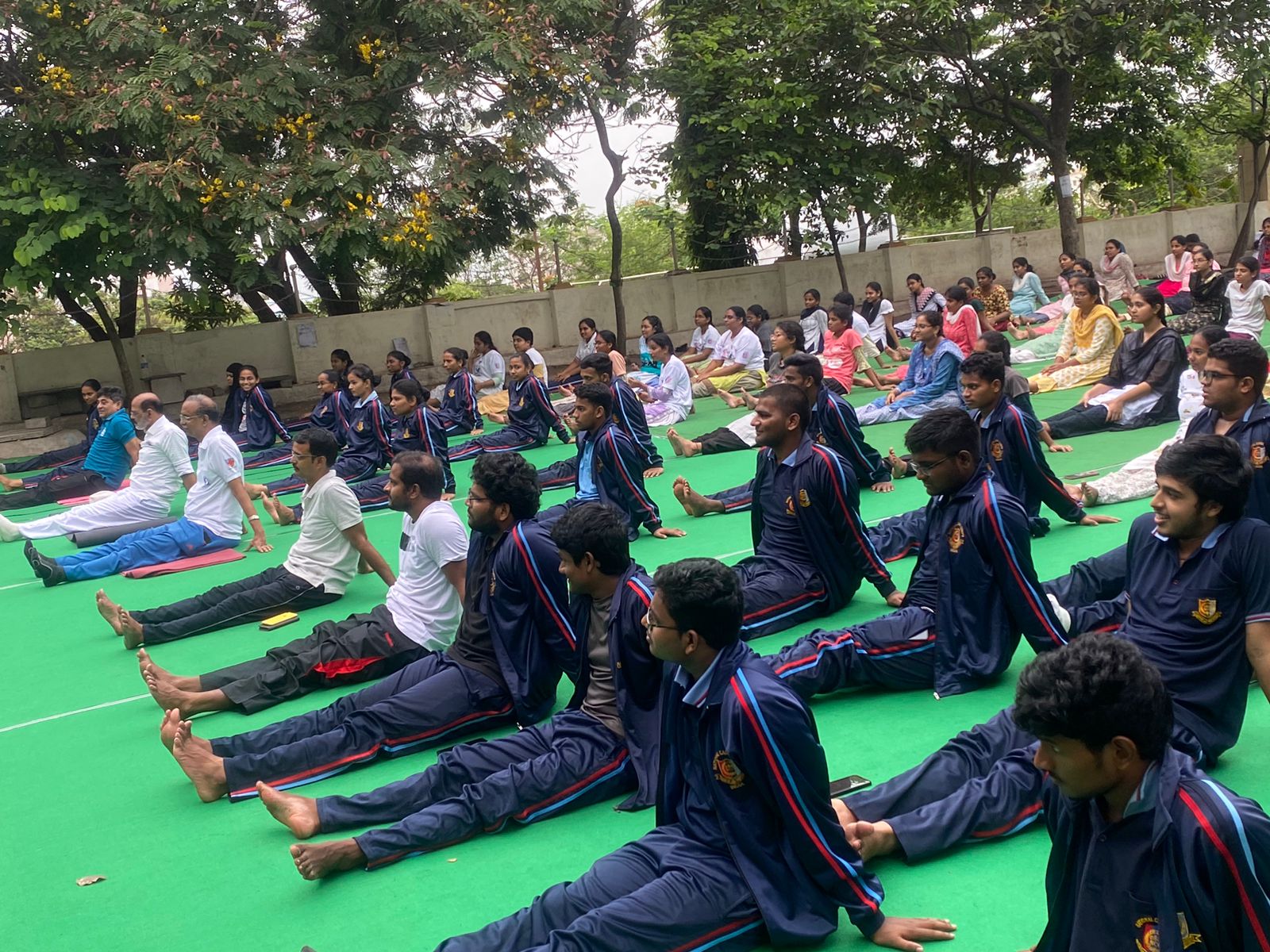
  • Yoga & stress management sessions
  • World Health Day activities
  • Screening camps
  • Student wellness programs

Importance of Physiology in Medicine

Physiology forms the scientific basis of clinical medicine. Understanding normal body function helps doctors:
  • Recognize disease processes
  • Interpret investigations
  • Understand pharmacology
  • Manage critically ill patients
  • Apply evidence-based medicine

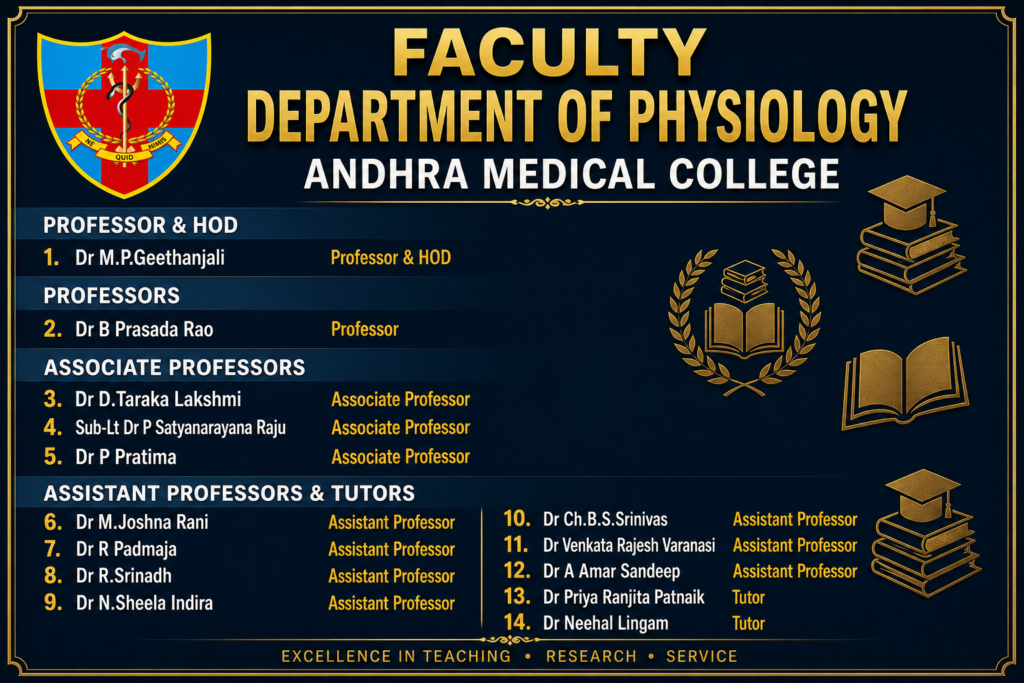
Typical Faculty Structure

The department commonly includes:

  • Professor & HOD
  • Professors
  • Associate Professors
  • Assistant Professors
  • Tutors/Senior Residents
  • Laboratory technicians

Infrastructure Commonly Present

  • Lecture hall – 1
  • Practical laboratories – 4
  • Demo rooms- 2
  • Models/charts
  • Research equipment
  • Audiovisual teaching aids

Department of Physiology

Andhra Medical College

  1. Department Profile (For NMC Inspection / Institutional Use)

Introduction

The Department of Physiology at Andhra Medical College is one of the core pre-clinical departments committed to excellence in medical education, research, and student training. The department plays a vital role in imparting foundational knowledge of normal human body functions to undergraduate and postgraduate students.

The department functions in accordance with the guidelines of the National Medical Commission (NMC) and actively implements Competency-Based Medical Education (CBME).

Objectives of the Department

To provide quality medical education in Human Physiology.

To develop clinical orientation among undergraduate students.

To promote research activities in physiological sciences.

To encourage self-directed and lifelong learning.

To support integrated and competency-based teaching methods.

Academic Activities

Undergraduate Teaching (MBBS)

The department conducts:

Theory classes

Practical sessions

Tutorials

Small group discussions

Integrated teaching

AETCOM sessions

Early Clinical Exposure (ECE)

Self-Directed Learning (SDL)

Practical Training Includes:

Hematology experiments

Clinical examination techniques

Blood pressure recording

Spirometry

ECG demonstration

Anthropometry

Human physiology experiments

Postgraduate Training

The department conducts:

Seminars

Journal clubs

Dissertation guidance

Research methodology training

Undergraduate teaching participation

Research Activities

Faculty and postgraduate students actively participate in:

Research publications

Conference presentations

Interdepartmental research

ICMR STS guidance

Clinical physiology studies

Infrastructure Available

The department is equipped with:

Lecture halls

Demonstration rooms

Hematology laboratory

Clinical physiology laboratory

Research laboratory

Seminar room

Audio-visual teaching aids

Models, charts, and educational displays

Assessment Methods

The department follows CBME-based assessment methods:

Formative assessment

Summative assessment

OSPE/OSCE

Practical examinations

Viva voce

Internal assessments

Faculty Development

Faculty members regularly participate in:

Faculty Development Programs

Medical education activities

Curriculum planning workshops

Contribution to Institution

The department contributes to:

Medical education reforms

Student mentoring

Institutional academic activities

Research promotion

Community health awareness programs

Vision Statement

“To be a center of excellence in Physiology education, research, and innovation by nurturing competent, ethical, and compassionate medical professionals.”

Mission Statement

To impart high-quality competency-based medical education in Physiology.

To promote critical thinking, scientific temperament, and clinical correlation among students.

To encourage research activities and evidence-based learning.

To foster professionalism, ethics, and communication skills.

To support holistic student development through innovative teaching-learning methods.

Core Values

Academic Excellence

Professionalism

Integrity

Compassion

Innovation

Lifelong Learning

Future Goals

Strengthening research activities

Enhancing simulation-based learning

Expanding interdisciplinary collaboration

Promoting student research projects

Adoption of advanced teaching technologies


Department of Physiology

Non-Teaching Staff 

S. No.Employee NameDesignationContact NumberE-Mail ID
1K. SatyavathiLab Technician9121734878kolli.satyavathi1978@gmail.com
2B.B. JeevithaLab Technician8500085635jeevithabb95@gmail.com
3Ramesh MOffice Subordinate9703010904
4M. Manga VeniOffice Subordinate9392708130venuvenkat84185@gmail.com
5P. Vijay KumarSweeper8341496095geethikasri90@gmail.com