






Andhra Medical College • Visakhapatnam
Department of Anatomy
Exploring the Human Body, Understanding Life and Building the Foundations of Medical Excellence.
Welcome to our Department
Building the Foundations of Medical Knowledge
The Department of Human Anatomy at Andhra Medical College, Visakhapatnam, plays a fundamental role in undergraduate and postgraduate medical education.
Through systematic study of the human body, practical dissection, anatomical demonstrations, museum learning and academic activities, the department provides students with a strong foundation for clinical medicine.
The department is committed to quality teaching, academic excellence, scientific curiosity and respect for human dignity.

Established Legacy
Andhra Medical College – 1923
Academic Programmes
MBBS and MD Anatomy
Anatomy Museum
Historical anatomical collections
Practical Learning
Dissection and anatomical demonstrations
Department Heritage & History
A Rich Academic Tradition
The Department of Human Anatomy has been functioning in its present block since 1962. It has played an important role in developing generations of medical graduates and postgraduate specialists.
The postgraduate programme in Anatomy began as an M.Sc. programme in 1935 and was subsequently developed into the MD programme.
The department continues its academic tradition through teaching, practical training, anatomical demonstrations and museum-based learning.
1923
Andhra Medical College established
1935
Postgraduate Anatomy programme began
1962
Present departmental block
1805
Year of historic skeleton collections
Academic Programmes
The department contributes to undergraduate and postgraduate medical education.
UNDERGRADUATE
MBBS – Professional Year I
Anatomy is an essential component of first-year MBBS education, providing the structural foundation for understanding normal human function and clinical medicine.
Learning areas include:
- Gross Anatomy
- Histology
- Embryology
- Neuroanatomy
- Radiological Anatomy
- Applied and Clinical Anatomy
POSTGRADUATE
MD – Anatomy
The MD Anatomy postgraduate programme provides advanced training in anatomical sciences, medical education and research. It develops specialists with the knowledge and skills required for academic, teaching and research responsibilities.
Academic focus includes:
- Advanced Gross Anatomy
- Advanced Histology and Embryology
- Neuroanatomy
- Medical Genetics
- Research Methodology and Dissertation
- Teaching and Demonstration Skills
- Applied and Clinical Anatomy
Anatomy Museum
Preserving anatomical heritage and enriching medical education through museum-based learning.
A Treasure of Anatomical Heritage
The Department of Anatomy houses one of the historically significant anatomy museums in South India.
Among its prized possessions are an ivory skeleton and a rosewood skeleton, made in 1805 by King Serfoji of Tanjore.
These collections represent an important part of the department’s historical and educational heritage.
Explore Museums of India →Learning Beyond Textbooks
Anatomical museum specimens support observation, identification and three-dimensional understanding of human structures.
Museum-based learning complements lectures, dissection demonstrations and practical teaching.
Cadaveric Oath Ceremony
Honouring the priceless gift of body donation and fostering respect, gratitude and responsibility among future doctors.
Departmental Academic Activity
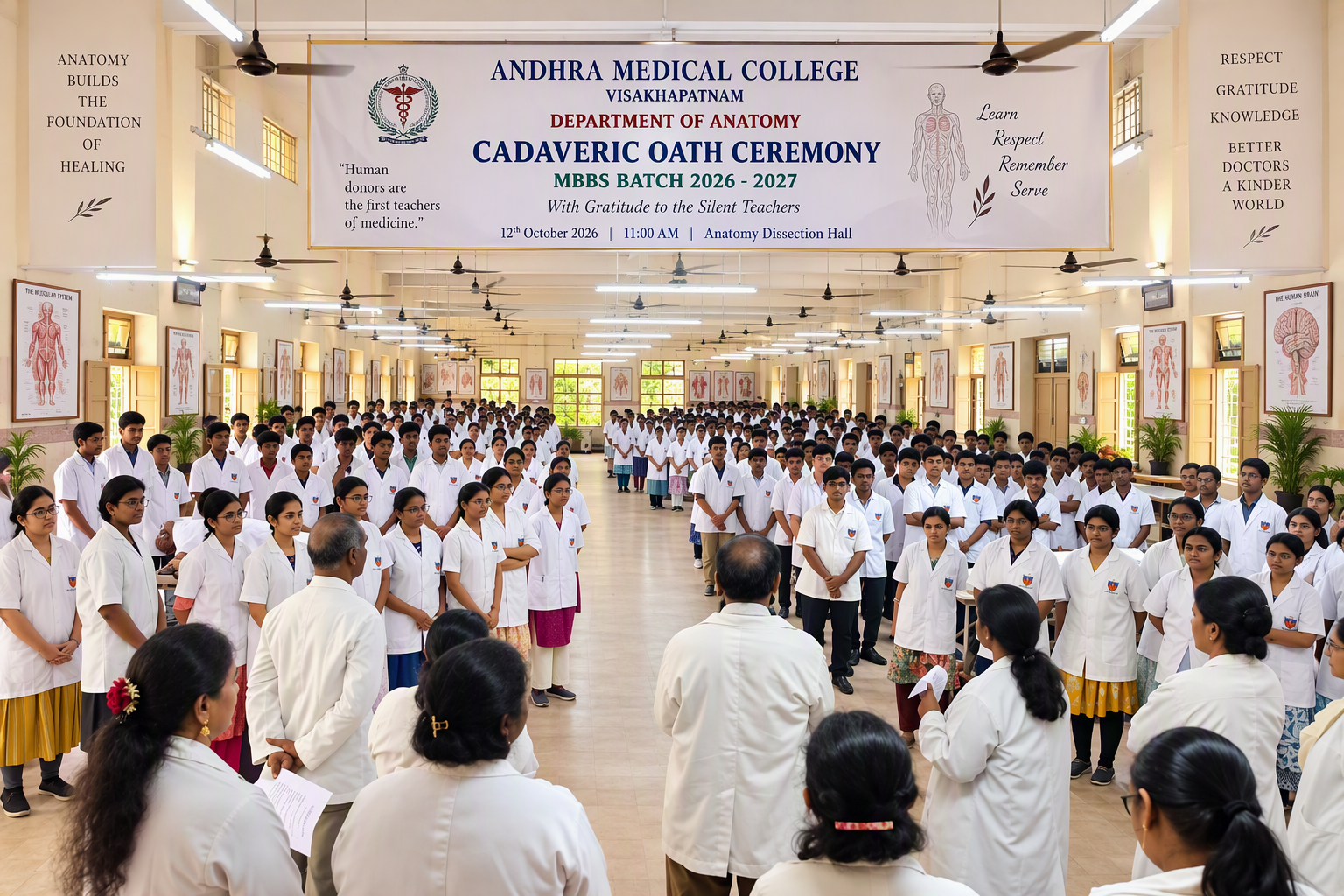
Cadaveric Oath Ceremony
The Cadaveric Oath Ceremony provides an opportunity for medical students to express gratitude and respect towards individuals who have donated their bodies for medical education.
It reinforces the values of empathy, professionalism, dignity and ethical responsibility in medical practice.
12 October 2026 | MBBS Batch 2026–2027
Venue: Anatomy Dissection Hall
Our Faculty
Dedicated to quality teaching, academic excellence and the development of future medical professionals.
Please verify the current faculty list and designations before updating the faculty directory.
Teaching & Learning Activities
A range of educational approaches supports competency-based undergraduate and postgraduate medical education.
📖 Didactic Lectures
Structured classroom teaching to establish core anatomical concepts and principles.
🔬 Dissection & Demonstrations
Practical exposure to human anatomy through supervised dissection and demonstrations.
🧫 Histology Practical
Microscopic identification and interpretation of tissues and organs.
🧠 Neuroanatomy
Understanding the structural organisation of the central and peripheral nervous systems.
🩻 Radiological Anatomy
Integration of anatomical knowledge with medical imaging and clinical applications.
👥 Small Group Learning
Interactive learning through discussions, demonstrations and collaborative activities.
Our Commitment
Quality Teaching • Innovative Research • Academic Excellence • Service to Humanity
Exploring the Human Body, Enriching Lives and Inspiring Future Doctors.
Contact Andhra Medical College
For academic and institutional enquiries, please contact Andhra Medical College.
Andhra Medical College
Medical College Road,
King George Hospital Campus,
Maharani Peta,
Visakhapatnam, Andhra Pradesh – 530002.
Telephone: 0891 2712258
Email: info@amc.edu.in
Official Website: www.amc.edu.in