




Forensic Medicine
& Toxicology
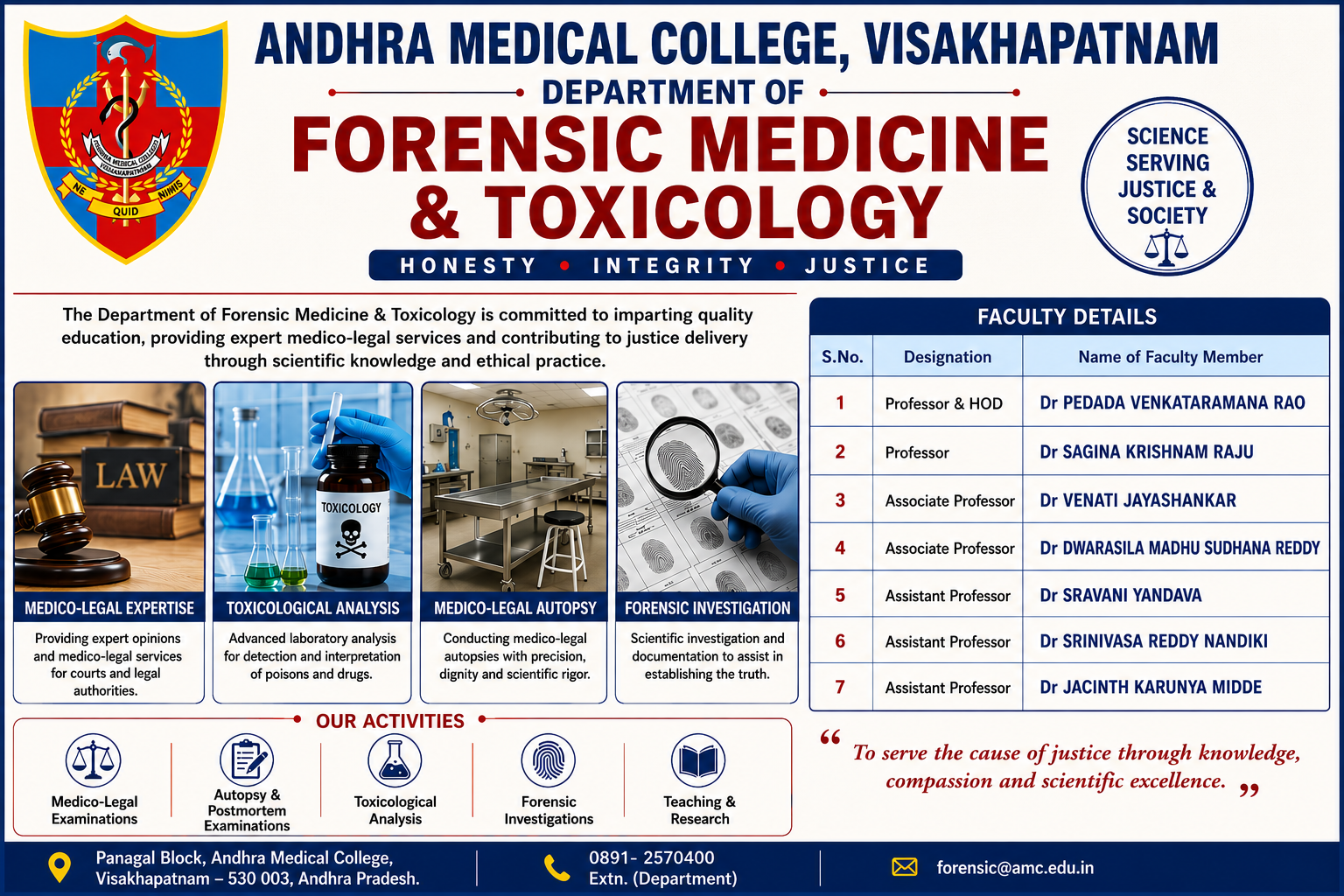
Advancing medical education, medico-legal science, forensic investigation and professional ethics through evidence-based medical practice.
*MD intake as listed in the AMC postgraduate course directory. Verify current approved intake before publication.
Science, Medicine and Justice
The Department of Forensic Medicine at Andhra Medical College was established in 1946. During its formative years, the subject was taught and medico-legal autopsies were undertaken by the Department of Pathology.
The department plays an important role in undergraduate and postgraduate medical education and in the medico-legal system through medical examinations, postmortem work, professional documentation and scientific interpretation.
The separate departmental block was initiated in 2008. The department also contributes to training of medical and police personnel and provides expert medical opinions in medico-legal matters.
A Distinguished Institutional Legacy
A department dedicated to medical education, scientific investigation, medico-legal responsibilities and professional ethics.
Knowledge • Evidence • Ethics • Justice
History of the Department
Important milestones in the evolution of Forensic Medicine at Andhra Medical College.
Forensic Medicine functions were initially carried out under the Department of Pathology.
The older departmental record notes that Forensic Medicine functions were separated from Pathology.
Dr. Valith is recorded in the historical departmental resource as the first full-fledged Professor.
The current official AMC webpage records the establishment of the Department in 1946.
Initiation of the separate block housing the Department.
Historical milestones are based on the AMC webpage and the earlier departmental website. Exact dates and designations should be checked against archival records.
Academic Programmes
Competency-based training integrating clinical skills, medico-legal responsibilities, scientific reasoning and professional ethics.
MBBS Undergraduate Teaching
- Forensic Medicine and Medical Jurisprudence
- Medico-legal examination and documentation
- Injuries and wound interpretation
- Postmortem examination and interpretation
- Medical ethics and professional responsibilities
- Clinical and legal aspects of poisoning
- Sexual offences and medico-legal examination
- Medical certification and court procedures
MD Forensic Medicine & Toxicology
- Advanced forensic pathology
- Medico-legal autopsy training
- Clinical forensic medicine
- Forensic toxicology
- Research methodology and dissertation
- Scientific presentations and journal clubs
- Expert opinion and court evidence
- Interdisciplinary academic activities
Professional Training
- Medico-legal orientation for medical officers
- Training for police personnel
- Medico-legal documentation
- Evidence preservation principles
- Professional communication and ethics
- Interdepartmental training activities
CBME Teaching and Certifiable Skills
Practical learning focused on the knowledge, skills and professional behaviour expected of an Indian Medical Graduate.
Medico-legal Documentation
Injury reports, age estimation, medical certificates, dying declarations and medico-legal records.
Clinical Forensic Examination
Examination and documentation of injuries, intoxication and sexual-offence cases in appropriate supervised settings.
Forensic Interpretation
Interpretation of postmortem findings, injury patterns and relevant forensic evidence.
Toxicology
Recognition, diagnosis and medico-legal aspects of common poisoning cases.
Evidence Preservation
Collection, sealing, labelling, preservation and dispatch of medico-legal exhibits.
Expert Medical Evidence
Scientific communication, professional responsibilities and testimony in court.
MD Forensic Medicine & Toxicology
Advanced postgraduate training in forensic pathology, clinical forensic medicine, toxicology, research and medico-legal practice.
View AMC PG Courses →Departmental Services and Professional Functions
Scientific medical support for medico-legal investigation, documentation and justice.
Medico-legal Autopsy
Postmortem examination and scientific interpretation in cases referred through the competent authorities.
Clinical Medico-legal Examination
Examination and documentation of injuries and other referred medico-legal cases.
Forensic Toxicology
Medical assessment and interpretation of suspected poisoning and toxicological cases.
Forensic Evidence
Principles of preservation, labelling, sealing and dispatch of relevant exhibits.
Expert Opinion
Scientific medical opinions and expert testimony when required by competent judicial authorities.
Medical Certification
Teaching and professional guidance on medico-legal documentation and medical certification.
Actual services and case acceptance are subject to departmental protocols, applicable law and competent authority referrals.
Facilities and Learning Resources
Infrastructure supporting teaching, postgraduate training and medico-legal work.
Departmental Block
Separate departmental block initiated in 2008.
Mortuary
Mortuary infrastructure supporting authorised medico-legal postmortem work.
Forensic Medicine Museum
Educational museum and teaching collections for demonstration of forensic concepts.
Departmental Library
Reference books and learning materials for undergraduate and postgraduate students.
Practical Teaching Facilities
Practical demonstrations, models, exhibits and structured learning resources.
Digital Learning Resources
Presentations, case discussions, academic schedules and digital study materials.
Poisoning, Toxicology and Patient Safety
Integrating clinical diagnosis, emergency management, toxicological principles and medico-legal responsibilities.
Clinical Toxicology
Recognition and initial management principles in common acute and chronic poisoning.
Analytical Toxicology
Introduction to toxicological laboratory methods and interpretation of laboratory findings.
Medico-legal Toxicology
Documentation, sample preservation and interpretation in suspected poisoning.
Research and Academic Activities
Promoting scientific investigation and evidence-based practice in Forensic Medicine and Toxicology.
Forensic Pathology
Research in injury interpretation, cause of death and postmortem findings.
Toxicological Research
Research relating to poisoning, toxicological profiles and clinical outcomes.
Medico-legal Research
Studies on injury patterns, medico-legal documentation and medical jurisprudence.
Journal Clubs
Critical appraisal of current research and scientific publications.
Seminars and Conferences
Academic presentations, case discussions and professional scientific meetings.
Postgraduate Dissertation
Research methodology, protocol development and dissertation training.
Training and Interdisciplinary Collaboration
The Department has an important role in training medical and police personnel in medico-legal responsibilities and scientific procedures.
Interdisciplinary collaboration with clinical departments, pathology, radiology, laboratory services, police authorities and the judiciary contributes to appropriate medico-legal assessment.
Professional Partnerships
Medical Officers
Police Personnel
Judicial Authorities
Clinical Departments
Forensic Science Laboratories
Faculty and Department Staff
Meet the faculty contributing to medical education, medico-legal work and research.
Forensic Medicine & Toxicology Faculty
Access the official Andhra Medical College department-wise faculty directory and faculty poster.
View Faculty Directory →Student and Faculty Resources
A central access point for academic materials, postgraduate information and departmental updates.
Departmental Study Materials
Space for syllabus, practical manuals, logbooks and presentations.
AMC Learning Resources →Department of Forensic Medicine & Toxicology
Andhra Medical College, Medical College Road,
Maharani Peta, Visakhapatnam – 530002,
Andhra Pradesh, India.